

Hosting capacity
Understanding hosting capacity
Hosting capacity information is useful for new investors looking to locate energy-using businesses in our region, as well as existing customers whose needs have changed. Two maps are available, one showing available capacity for load (power flows from the network to the customer), the other for generation (customer delivers power to the network). The maps show our high voltage sub-transmission and distribution lines, as well as most distribution substations. Choose a map, then click on a line or a substation to see the hosting capacity.
Northpower intends to review the maps every three months, with a full data regeneration once per year. The hosting capacity data is our best estimate as of the date of publication. The maps show approximate hosting capacity. The data must not be relied upon for detailed design work or investment decisions.
When you make a connection application, we will perform a detailed, site-specific assessment to determine the actual available capacity and any required infrastructure upgrades. For large connections, there may be a charge for this assessment.
Network development projects
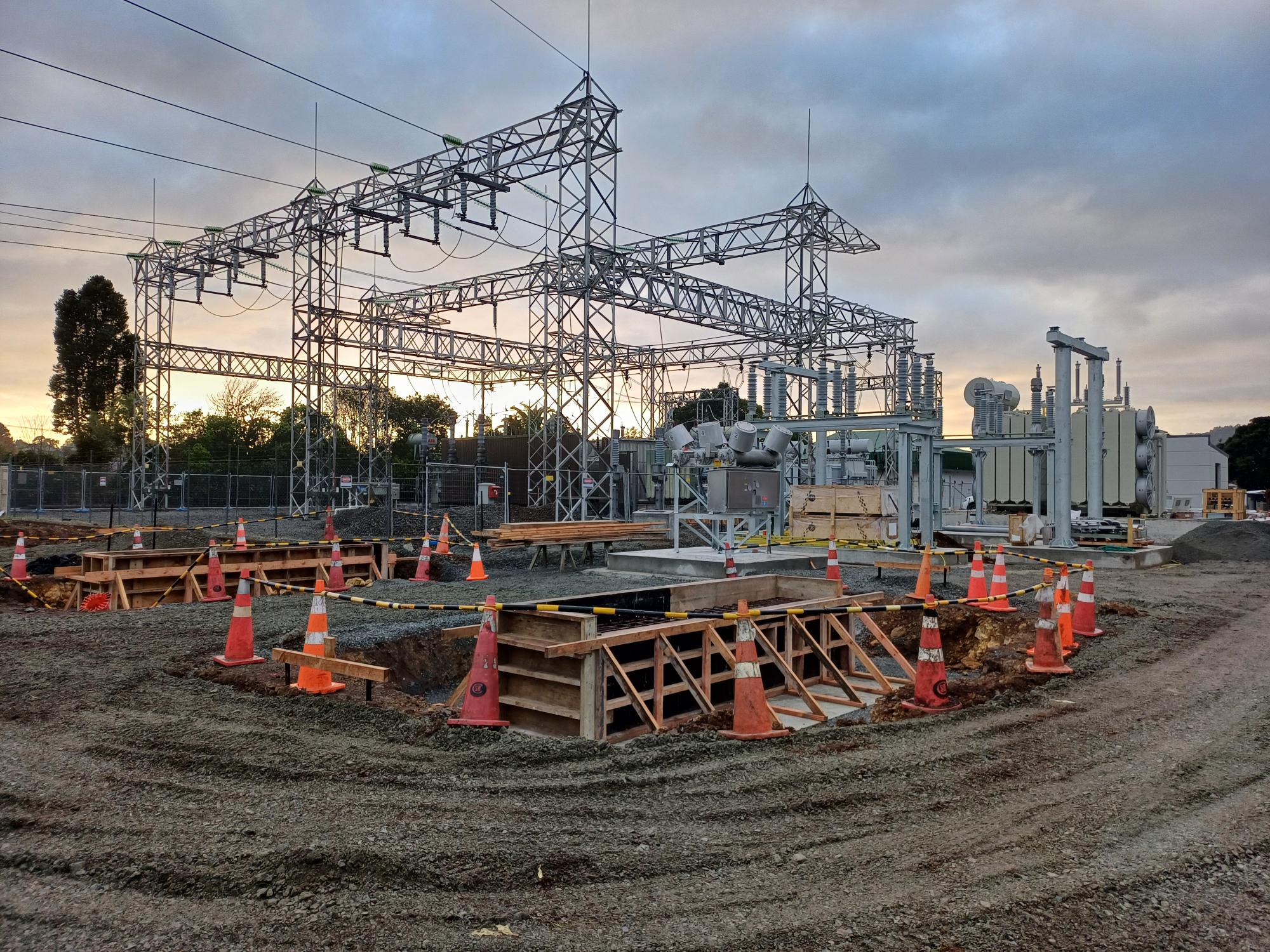
Network development projects are works we carry out on our network, usually to replace outdated equipment or adapt to changes in network demand. Usually (but not always), network development projects increase hosting capacity.
We have listed committed network development projects expected to be delivered in the short to medium term, with an indication of the areas where hosting capacity may be affected. Further details can be found in our asset management plan or by contacting us.
The table below is an overview of Network Development Projects that may affect hosting capacity at the locations listed. The expected delivery date is based on the financial year (e.g. 2027 begins on 1 April 2026 and ends on 31 March 2027).
| Project Title | Capacity Impacted Area | Expected Delivery Financial Year |
|---|---|---|
| WHG to ALX 33kV Oil Cable Replacement | Whangarei South CB82 | 2028 |
| Maungaturoto to Mangawhai 34km 33kV Line | Maungaturoto POS CB1222, Kaiwaka CB52, Mangawhai Central, Mangawhai North, Kaiwaka | 2028 |
| Maungaturoto Transformer Replacements (10MVAx2) & Switchboard Upgrade | Maungaturoto | 2026 |
| Bream Bay Distribution Feeder Installation (Network cont) | Bream Bay CB1107 | 2026 |
| Bream Bay T2 and 11kV Switchgear Installation | Bream Bay | 2027 |
| Maungatapere 110/33kV Transformer Replacement & Upgrade | Maungatapere POS | 2028 |
| RKA CB1/CB6 Reconfiguration | Ruakaka CB1, Ruakaka CB6 | 2026 |
| Install new 33 kV cable from Kensington to Kamo Substations | Kensington CB7, Kensington CB2, Kamo, Hikurangi, Kamo CB72, Kamo CB82, Hikurangi CB72 | 2028 |
| Kensington Upgrade programme | Kensington | 2027 |
| WHG to ALX 33kV Oil Cable Replacement | |
| Capacity Impacted Area: Whangarei South CB82 | Expected Delivery Financial Year: 2028 |
| Maungaturoto to Mangawhai 34km 33kV Line | |
| Capacity Impacted Area: Maungaturoto POS CB1222, Kaiwaka CB52, Mangawhai Central, Mangawhai North, Kaiwaka | Expected Delivery Financial Year: 2028 |
| Maungaturoto Transformer Replacements (10MVAx2) & Switchboard Upgrade | |
| Capacity Impacted Area: Maungaturoto | Expected Delivery Financial Year: 2026 |
| Bream Bay Distribution Feeder Installation (Network cont) | |
| Capacity Impacted Area: Bream Bay CB1107 | Expected Delivery Financial Year: 2026 |
| Bream Bay T2 and 11kV Switchgear Installation | |
| Capacity Impacted Area: Bream Bay | Expected Delivery Financial Year: 2027 |
| Maungatapere 110/33kV Transformer Replacement & Upgrade | |
| Capacity Impacted Area: Maungatapere POS | Expected Delivery Financial Year: 2028 |
| RKA CB1/CB6 Reconfiguration | |
| Capacity Impacted Area: Ruakaka CB1, Ruakaka CB6 | Expected Delivery Financial Year: 2026 |
| Install new 33 kV cable from Kensington to Kamo Substations | |
| Capacity Impacted Area: Kensington CB7, Kensington CB2, Kamo, Hikurangi, Kamo CB72, Kamo CB82, Hikurangi CB72 | Expected Delivery Financial Year: 2028 |
| Kensington Upgrade programme | |
| Capacity Impacted Area: Kensington | Expected Delivery Financial Year: 2027 |
Frequently asked questions
They use Geographic Information System (GIS) technology to display current network infrastructure and indicate available or spare capacity to accommodate additional demand or generation.
They are primarily intended for developers, builders, and large-scale customers (e.g., EV charging infrastructure providers, solar project developers) who need to assess the feasibility of new projects and connections.
Network capacity refers to the maximum amount of load or generation the existing infrastructure (like a transformer or line) can safely handle at any given time without impacting reliability or requiring upgrades
The hosting capacity data is our best estimate as at the date of publication. We intend to review the maps every three months, with a full data regeneration once per year. The maps show approximate hosting capacity. The data must not be relied upon for detailed design work or investment decisions.
Maps are intended to be reviewed every three months, with a full data regeneration once per year. The maps show approximate hosting capacity. The hosting capacity data is our best estimate on the date of publication. Capacity is dynamic, so some available capacity may already be contracted to other users but not yet fully utilised.
Not necessarily. Even in areas that show capacity available, minor or major upgrades may be required.
The maps are a tool to help you identify the most viable locations. If you wish to proceed with a project, you must submit a formal application for connection to our network operator. They will then perform a detailed, site-specific assessment to determine the actual available capacity and any required infrastructure upgrades.
Connections are often still possible, but they will likely require significant and expensive network reinforcement or upgrades to overcome the constraints. This can increase project costs and timelines.
Generally, the developer or connecting customer is responsible for the costs of new network infrastructure specific to their property, while Northpower covers assets that benefit the wider network. Refer to Northpower’s Capital Contributions Policy for detailed information on charges.
Yes, we have capacity maps showing available capacity for electricity in ‘both directions’. There are two separate maps, one for load and one for generation.
The map only covers the Northpower network area (Whangārei and Kaipara regions). For areas north of the boundary, customers need to check with Top Energy, and for areas south, with Vector.
Disclaimers
You acknowledge and agree that your use of these maps is subject to the disclaimer below and the Terms of Use included with the relevant map.
Hosting capacity data on Northpower maps is an estimate only, and we don’t make any guarantee, representation or warranty about the currency, accuracy, reliability, suitability or completeness of it.
As such, and to the fullest extent permitted by law, Northpower:
- excludes all representations and warranties relating to the data contained in the maps, including in relation to any inaccuracies or omissions in it; and
- accepts no liability for any loss, damage (including indirect or consequential damage), cost, expense, loss of profit and loss of any other kind suffered or incurred (whether foreseeable or not) arising from its use.
Our maps cover hosting capacity on the high voltage (HV) network and at low voltage (LV) distribution substations only. The data is intended for large-scale customers to help with their preliminary feasibility and site selection. The data is not appropriate for residential customers looking to upgrade their connection or to install generation such as rooftop solar. If you want to progress a project, we can work with you to understand more accurately what capacity is available for your specific needs.
Hosting capacity data assumes all network assets are in service. Faults or other network outages may affect hosting capacity and security of supply. With all assets in service, security of supply is: N-1 for sub-transmission and parts of our 11kV network; N for 11kV spurs and all LV networks.
Map contents and availability may be subject to change without notice. The data in the hosting capacity maps is intended to be reviewed every three months and was last updated on 10 February 2026.
