

Trees near power lines
If there is immediate danger
Call 111 immediately if there is an emergency.
Never touch a power line, and never touch a tree or branch that is touching a power line. If you come across downed lines, never approach or attempt to clear them yourself. Stay at least 10 metres away and call 111.
You should also contact us immediately if:
- a tree or branch has fallen onto a power line
- a tree looks like it could fall onto a power line soon
- a power line is down, damaged, or hanging low
- branches are touching lines
- someone is at risk of coming into contact with the line
Who is responsible for a tree near a power line?
In most cases, the tree owner is responsible for making sure their tree doesn’t grow too close to power lines. A tree owner is usually the person who owns the land where the tree is growing.
As your local lines company, we have responsibilities too. These include:
- carrying out line and vegetation surveys
- providing information about the rules
- issuing hazard warning notices and cut or trim notices where the regulations allow or require
- responding to electricity hazards
- in some cases, meeting the cost of certain work required under the regulations
How the rules apply
The regulations use several zones around power lines. These zones help determine when trees must be trimmed, when notices can be issued, and what restrictions apply.
Trees growing too close to a power line
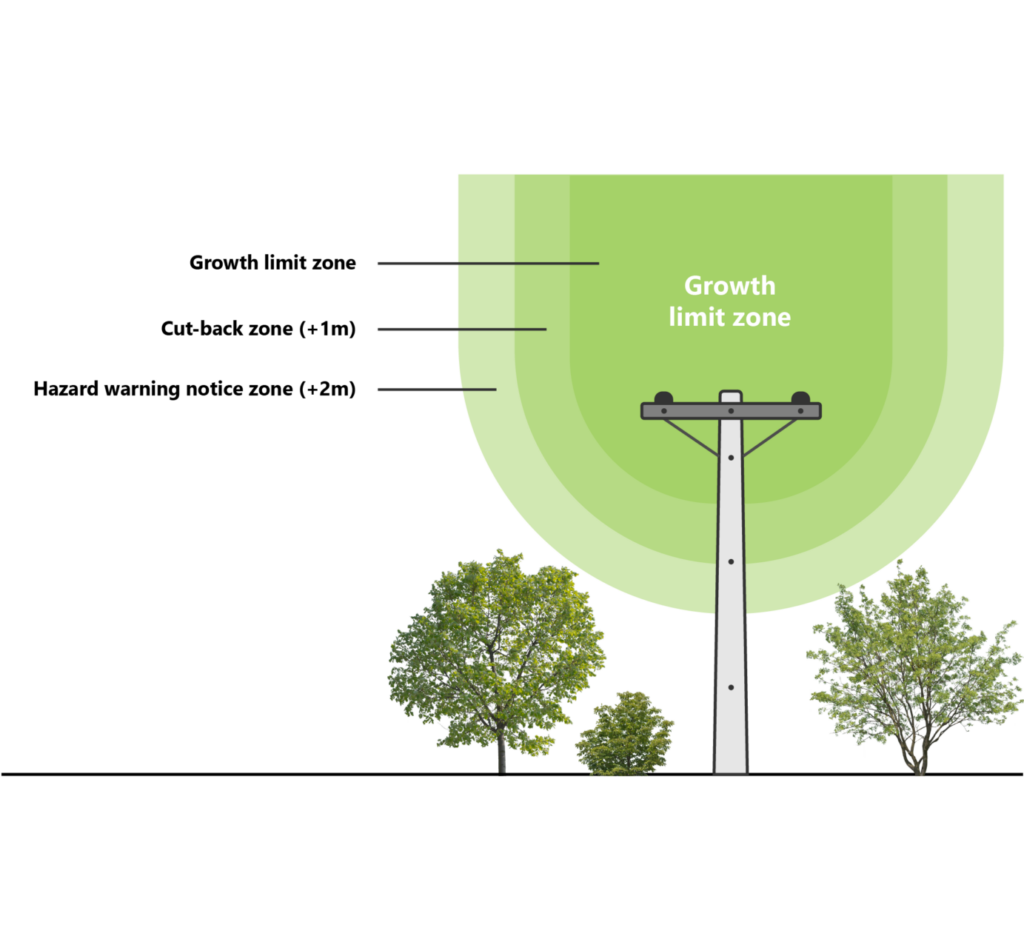
The regulations include three zones around a power line. These help explain when vegetation is getting too close and when it needs to be cut back.
Growth limit zone: The space immediately around a power line that must be kept clear of vegetation. The size and shape of the growth limit zone depends on the voltage of the line and, in some cases, the span length of the line.
Cut-back zone: This extends 1 metre out from the growth limit zone. If a tree is growing into the growth limit zone, it needs to be trimmed back far enough to reach the cut-back zone unless a dispensation applies.
Hazard warning notice zone: This extends 2 metres out from the growth limit zone. If vegetation enters this zone, we may issue a hazard warning notice to alert the tree owner.
If a tree qualifies for its first cut or trim under the regulations, we will pay for that work. After that, keeping the tree clear of the power line, and paying for any trimming that’s needed, is the tree owner’s responsibility.
Different rules can apply in some circumstances, so check with us if you are unsure.
Trees that could fall into a power line
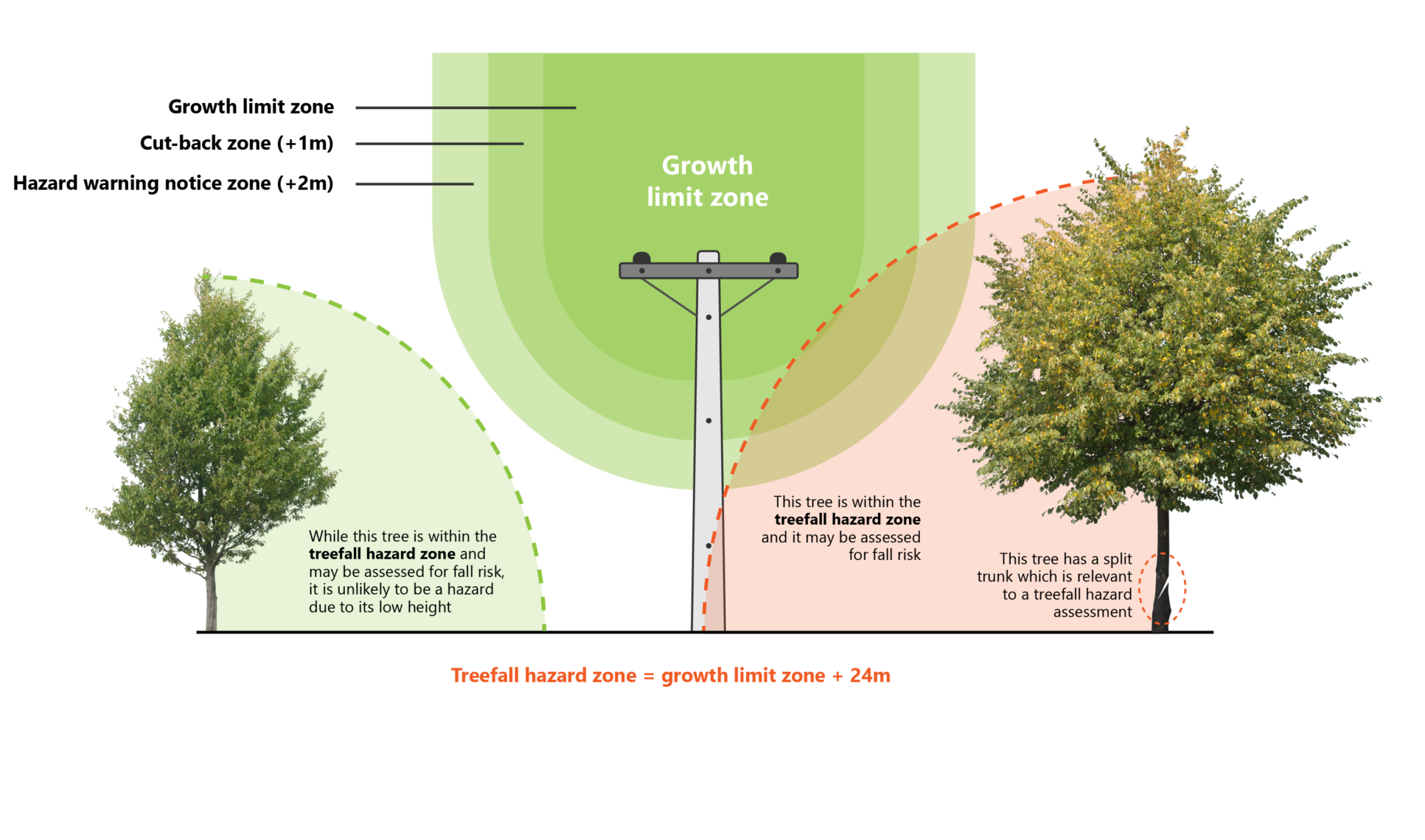
The treefall hazard zone is an area that extends 24 metres from the growth limit zone.
Trees within this zone may be assessed by a lines company. This does not mean every tree in the zone is a hazard. It means the tree may be assessed if there is concern that, because of its condition, size or location, it could fall onto the power line. A formal treefall hazard notice can only be issued if the tree is assessed as a moderate or high hazard.
Treefall hazard notices will not be issued before 23 July 2028. Before then, we may use voluntary processes to discuss hazardous trees with tree owners. These voluntary processes are separate from the formal treefall hazard notice power in the regulations.
Planting a new tree near a power line
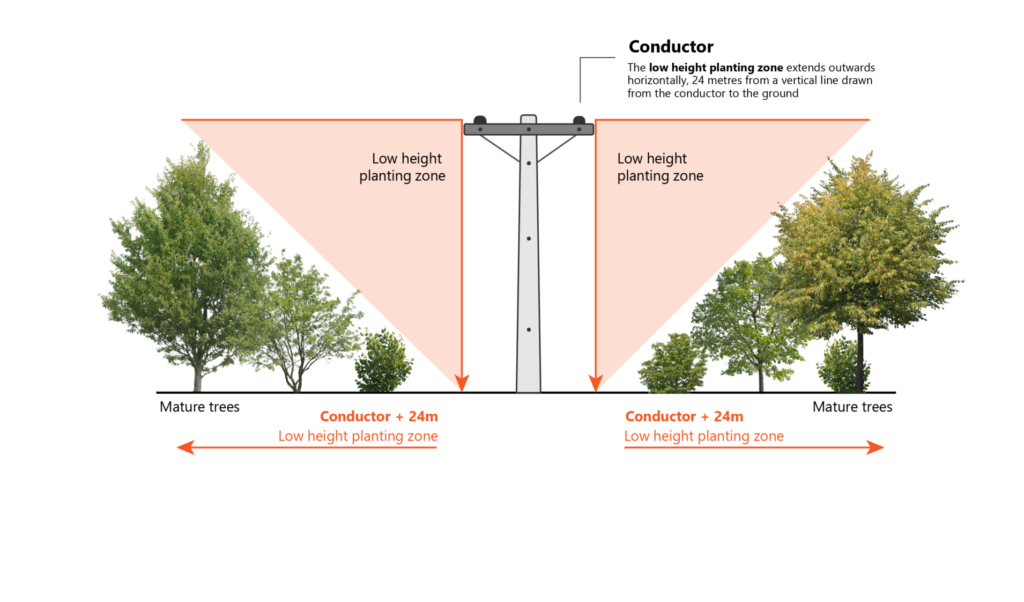
On 23 July 2027, a low height planting rule comes into effect. This means you must not plant a tree if you reasonably expect it could grow taller than its distance from the power line.
The low height planting zone extends 24 metres horizontally from the power line.
If you plant a tree in breach of this rule:
- you may be liable for damages
- you may be responsible for the cost if the tree later needs to be cut, trimmed or removed
- you cannot use a ‘no-interest’ tree notice to transfer responsibility for managing the tree to the lines company.
The planting restriction does not apply to trees that grow naturally. However, if a self-sown tree within the low height planting zone later needs to be cut, trimmed or removed, the tree owner may be responsible for the cost.
Find more on trees suitable for growing near power lines.
There are some exceptions. The low height planting zone does not apply:
- on existing forest land
- in urban areas
- to shelterbelts
- on land administered under the Conservation Act 1987.
Not sure whether your property is in an urban area? Check your district plan or contact your local council.
Vegetation growing above the line
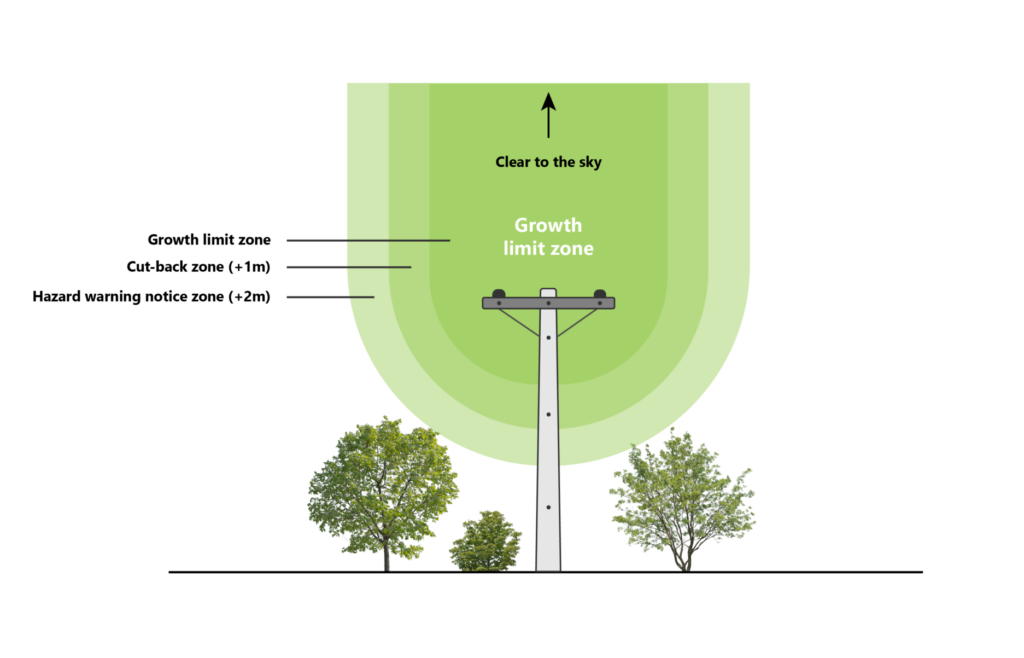
For some power lines, the growth limit zone extends vertically above the line as well as around it. This is known as ‘clear to the sky’ and means vegetation must also be kept clear above the line.
Clear to the sky already applies to higher-voltage lines in both urban and non-urban areas. From 17 October 2026, it will also apply to lines at 11 kV or below outside urban areas.
What happens if a tree grows too close to a line?
If a tree is too close to a power line, we may contact the tree owner. Depending on the situation, this may include:
- providing information or advice
- issuing a hazard warning notice
- requiring the tree to be cut back
- taking further action allowed under the regulations if the issue is not addressed.
The exact process depends on the type of risk and which rules apply. If you receive a notice, it’s important to read it carefully and act within the required timeframe.
Maintain a safe distance
Voltage
Power lines (230-400 V)
High voltage lines (11 kV)
High voltage lines (33 kV)*
High voltage lines (50-66 kV)*
High voltage lines (66 kV or more)*
*Clear to the sky requirement
Growth Limit Zone
0.5m
1.6m
2.5m
3.0m
4.0m
Cut-Back Zone
1.5m
2.6m
3.5m
4.0m
5.0m
Notice Zone
2.5m
3.6m
4.5m
5.0m
6.0m
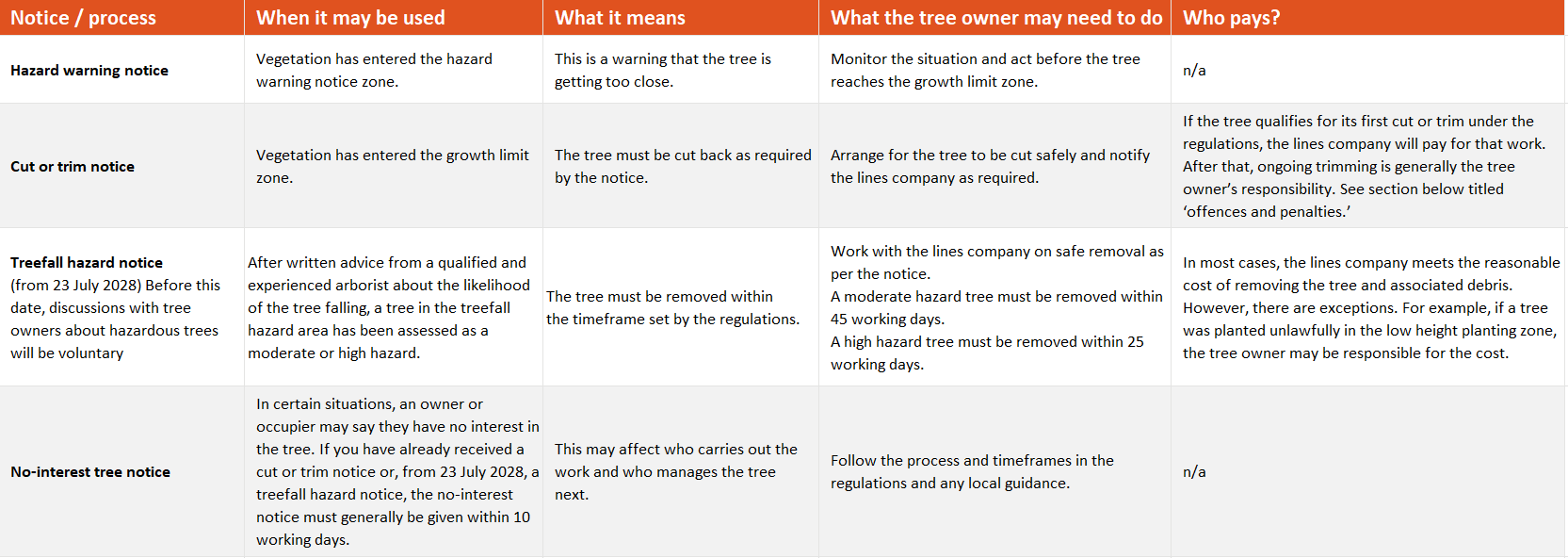
Tree notices and what they mean
What if I disagree with a notice or assessment?
Different review or dispute options may be available depending on the type of notice or issue.
For some matters under the regulations, disputes may be referred to the Tree Arbitrator. The WorkSafe website lists the current Tree Arbitrator and further information. Some issues may also be raised with Utilities Disputes, depending on the complaint.
If you disagree with a notice you receive, contact us as soon as possible so the next steps can be explained.
Offences and penalties
Tree owners can be fined if they do not meet certain requirements under the regulations.
Cut or trim notices
A tree owner might commit an offence if, without reasonable excuse, they:
- do not have a tree cut or trimmed as required by a cut or trim notice
- do not tell [us / your local lines company] the time and location of the work at least three working days before it takes place.
If convicted, the tree owner may be fined up to $10,000. If the offence continues, a further fine of up to $500 for every day or part of a day may apply.
Treefall hazard notices — from 23 July 2028
From 23 July 2028, a tree owner may commit an offence if, without reasonable excuse, they:
- do not have a tree removed within the timeframe required by a treefall hazard notice
- do not tell [us / your local lines company] the time and location of the removal as required.
If convicted, the tree owner may be fined up to $10,000.
Low height planting zone
Not complying with the low height planting zone restrictions is not itself an offence. However, it may affect who is responsible for the cost of future tree trimming or removal and the options available to the tree owner under the regulations.
Can I trim or remove the tree myself?
If you, the tree, or any tools or equipment could come within 4 metres of a power line, do not attempt the work yourself. Contact us first.
Cutting or removing trees near live power lines is dangerous. It can lead to serious injury, electric shock, fire, power outages, and damage to property or electricity infrastructure. Trees or branches can fall or swing unexpectedly, and electricity can arc to nearby objects even without direct contact.
Work near power lines may need to be carried out by a qualified contractor, or the line may need to be isolated before work begins.
If you’re unsure, contact us before doing any work.
Find the approved tree trimming contractors below.
Need a tree trimmed?
These contractors are also approved by us to work near lines:
Northpower Vegetation
Phone: 09 988 9254
Email: [email protected]
Think Trees Arborist Services Northland
Phone: 021 0238 6231
Email: [email protected]
Treescape
Phone: 0800 873 396
Email: [email protected]
T8 Tree Services
Phone: 021 960 920
Email: [email protected]
Tree Safe
Phone: 09 411 5076 or 0800 TREESNZ
Email: [email protected]
Can a lines company enter my property?
In some circumstances, the regulations allow us to enter land to inspect trees or carry out work.
If access is needed, we will follow the relevant legal requirements and local process. In some situations relating to treefall hazard removal, we may also ask for the tree owner’s consent to enter the property and remove the tree.
If you have questions about access, please contact us.
Frequently asked questions
Stay well clear. Do not touch the tree, branch, power line, or anything that is in contact with them. Call 111 if there is immediate danger, then contact us on 0800 10 40 40. Always treat power lines as live.
If you, the tree, or any tools or equipment could come within 4 metres of a power line, do not attempt the work yourself. Contact us first. Cutting or removing trees near live power lines is dangerous and may require a qualified contractor or the line to be isolated.
In most cases, the tree owner is responsible for managing their trees so they do not breach the regulations. Your local lines company also has responsibilities, including monitoring vegetation risks, issuing notices, responding to electrical hazards and, in some circumstances, meeting the cost of work. The exact responsibility depends on the tree and the type of notice involved.
The treefall hazard zone is an assessment area extending 24 metres from the edge of the growth limit zone. A tree within this area may be assessed if there is concern that it could fall onto a power line. Being inside the zone does not automatically mean a tree is hazardous or must be removed.
A treefall hazard notice is a formal notice requiring the removal of a tree that has been assessed as a moderate or high hazard to a power line. Formal treefall hazard notices cannot be issued before 23 July 2028. Before then, a lines company may ask a landowner to agree voluntarily to the removal of a hazardous tree, but that request is not a formal treefall hazard notice.
The notice will explain the assessment and the action required. A tree assessed as a high hazard must generally be removed within 25 working days. A tree assessed as a moderate hazard must generally be removed within 45 working days. The tree owner must also tell the lines company when and where the removal will take place, as required by the notice.
The lines company will generally meet the reasonable cost of removing the tree and associated debris. Exceptions apply. For example, the tree owner may be responsible if the tree was planted in breach of the low height planting rules. A lines company may also no longer be required to meet the cost if the tree owner refuses consent for the lines company to enter the property and remove the tree.
The regulations use the zoning in the relevant district plan or proposed district plan. The definition may not match the way an area is described in everyday language. If you’re unsure whether your property is in an urban area, check your district plan or contact your local council.
A shelterbelt is one or more rows of trees planted to protect farming or horticultural land — including animals or crops — from the weather. A row of trees along a boundary is not automatically a shelterbelt; its purpose is what matters.
Contact us and your local council before arranging work. Additional requirements or permissions may apply, but the tree must still be managed safely. Do not trim or remove a protected tree near a power line without first checking the correct process.
A dispensation may allow a tree to remain closer to a power line than the normal cut-back zone, subject to conditions. It does not allow the tree to grow into the growth limit zone beyond the distance specified in the dispensation. If you have received a cut or trim notice, an application needs to be made within five working days. Dispensations are not available in some low height planting zone situations.
The regulated distances depend on the voltage and span of the line, so they are not always easy to judge. Do not try to measure around a live line. Contact us if you are concerned about a tree or are planning work near a line.
A hazard warning notice alerts a tree owner that vegetation has entered the hazard warning notice zone and may continue growing towards the growth limit zone. A cut or trim notice is issued when a tree has entered the growth limit zone and requires the tree owner to have it cut back. Each notice will explain what it relates to and what the tree owner needs to do.
Read the notice carefully and contact us promptly if anything is unclear. The notice will set out the work required, the deadline, and the options available to you. You must tell us the time and location of the work at least three working days before it takes place. Do not arrange work that cannot be carried out safely. If you need guidance on who can carry out the work, contact us for advice.
It depends on the circumstances. If a tree qualifies for its first cut or trim under the regulations, the lines company generally meets the reasonable cost. Ongoing maintenance is generally the tree owner’s responsibility. Different rules can apply where there is an agreement, a no-interest tree notice, refused access, a tree planted unlawfully in the low height planting zone, or a self-sown tree that establishes there and is not managed. Contact us about your situation.
The low height planting zone is an area extending 24 metres horizontally from a power line on unforested land outside an urban area. From 23 July 2027, a person must not plant a tree in this zone if they have reasonable grounds to believe its mature height will be greater than its distance from the line. The rule does not apply to existing forest land, urban areas, shelterbelts, or land administered under the Conservation Act 1987.
The planting restriction does not apply retrospectively to trees that were already established before 23 July 2027, or to trees that grow naturally. However, these trees can still be covered by other rules about vegetation near power lines. Different rules about who pays for trimming or removal can also apply to self-sown trees within the low height planting zone.
For some power lines, the growth limit zone extends vertically above the line as well as around it. This prevents vegetation forming a tunnel over the line. Clear to the sky already applies to higher-voltage lines in both urban and non-urban areas. From 17 October 2026, it will also apply to lines at 11 kV or below outside urban areas.
The regulations allow a lines company to enter land in some circumstances to inspect trees or carry out work. The lines company must follow the relevant notice and access requirements. For removal under the treefall hazard framework, the lines company may ask for the tree owner’s consent to enter the property and carry out the work.
Contact us as soon as possible so we can try and resolve the matter. The options depend on the type of notice or dispute, and some time limits are short. Certain matters can be referred to the Tree Arbitrator. Other complaints may be considered by Utilities Disputes Limited.
In some circumstances, a tree owner can formally tell the lines company that they have no interest in a tree. This is called a no-interest tree notice. The lines company may then choose to manage the tree, subject to the rules about access and who pays. If you have already received a cut or trim notice or, from 23 July 2028, a treefall hazard notice, the no-interest notice generally needs to be given within 10 working days. This option is not available for trees planted in breach of the low height planting rules.
Failing to comply with certain requirements without reasonable excuse can be an offence. A tree owner may be fined up to $10,000. For a continuing offence involving a cut or trim notice, a further fine of up to $500 for each day or part of a day may apply. The treefall hazard notice offences apply from 23 July 2028 and carry a fine of up to $10,000.
